

New Technology
Tima-X
Tescan
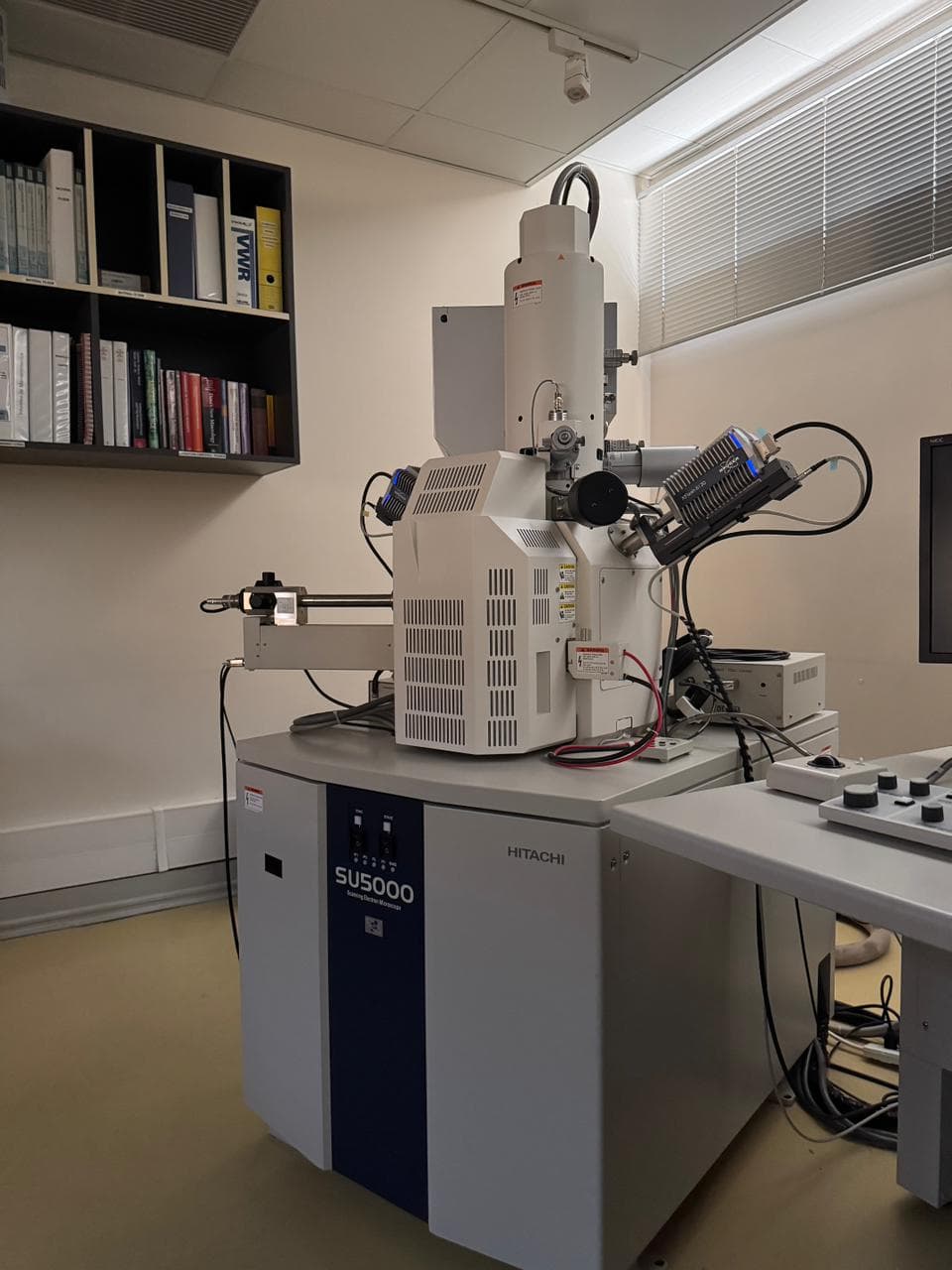
Capabilities and Measurements
- ›High-resolution automated mineralogy and liberation analysis.
- ›Identification of mineral phases based on their chemical composition.
- ›Determination of modal mineralogy in solid samples.
- ›Evaluation of particle liberation degree and mineral associations.
- ›Textural characterization and grain size distribution.
📦
✓Submission Requirements
- Representative sample of the material to be analyzed, correctly labeled.
- Dry and homogeneous material.
- Required mass: approximately 100 g per sample.
- Particle size appropriate for the analysis.
- Indicate sample type (feed, concentrate, tailings, synthetic, etc.) to define the preparation protocol.
- Inform if the sample is water-soluble or has reactive behavior that may affect its preparation.
⚙Sample Preparation
- Samples are prepared in the laboratory as briquettes (polished sections).
- The process includes homogenization, deagglomeration and mixing with resin for mounting.
- A polishing step then produces a flat surface suitable for automated analysis.
- Preparation is critical to ensure representativeness and quality of results.
!Technical Limitations
- Resolution dependent on particle size and analysis conditions.
- Difficulty differentiating phases with similar chemical compositions.
- Sensitive to briquette preparation quality.
- Soluble, unstable or reactive materials may present preparation difficulties and must be evaluated on a case-by-case basis.
- Results depend on the mineral phase list (SIP) used in the analysis; new mineralogies not in the list may require additional time and cost.
- Detection limit of the analysis on the order of ~0.1 wt%, depending on the material.
- Limited for elements up to Be.